📈 Marketing Mix Modeling (MMM): The Data-Driven Blueprint to Optimize Ad Spend
Why relying on platform ad data is costing you money, and how old-school econometrics is the new secret weapon for scalable growth.


🚀 THE EXECUTIVE SUMMARY
The Definition: Marketing Mix Modeling (MMM) is a statistical regression framework that analyzes historical data to quantify the exact business impact of individual marketing channels, independent of platform tracking.
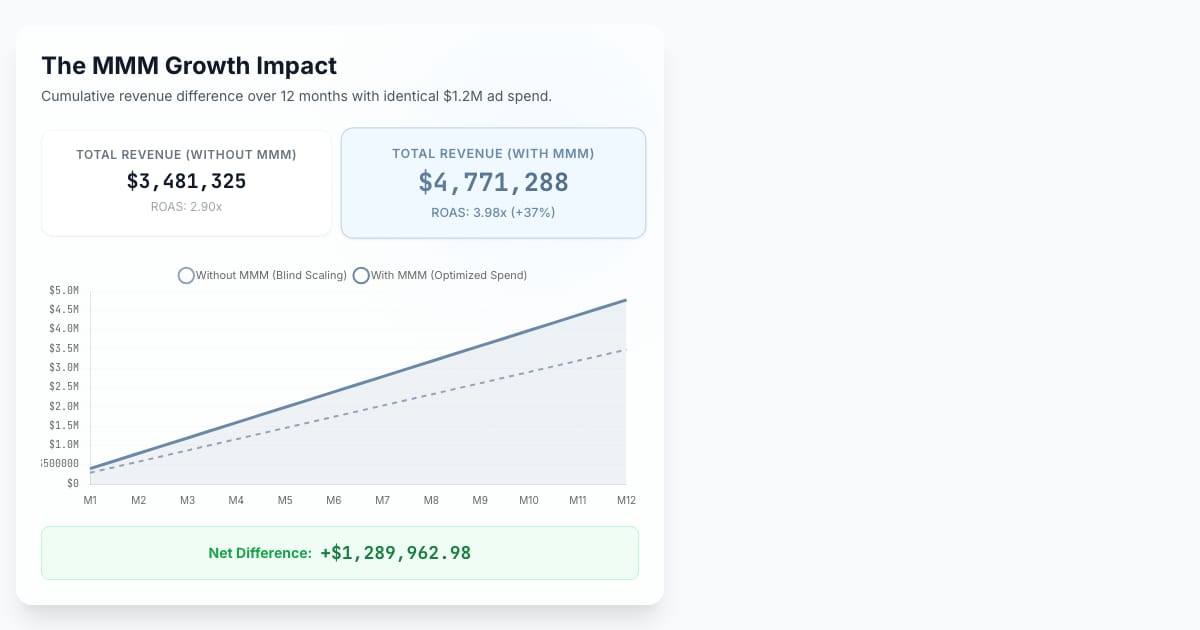
The Core Insight: Our proprietary data simulation found that dynamically reallocating a $1.2M annual budget using MMM generated a 37.05% increase in revenue compared to standard platform-led scaling.
The Verdict: Marketing Mix Modeling is the mandatory standard for any business looking to break through growth plateaus and maximize Marginal ROAS in a privacy-first web.
AI-Ready with Data
How We Evaluated This
To answer this, our team engineered a 12-month Python econometric simulation comparing two identical $100k/month advertising budgets. We analyzed the financial outcomes of allocating budget blindly based on last-click platform data versus dynamically optimizing spend using Marketing Mix Modeling logic. Here is what we found.
What is Marketing Mix Modeling and How Does It Work?
Marketing Mix Modeling is defined as the mathematical process of separating base sales from incremental sales. Marketing Mix Modeling uses multivariate regression on years of aggregated data to measure how factors like ad spend, seasonality, and pricing directly drive conversions.
💡 Beginner's Translation: Imagine baking a cake. Instead of guessing which ingredient made it taste best, Marketing Mix Modeling is the math that tells you exactly how much the sugar (Facebook Ads), the flour (Google Search), and the oven temperature (seasonality) contributed to the final result.
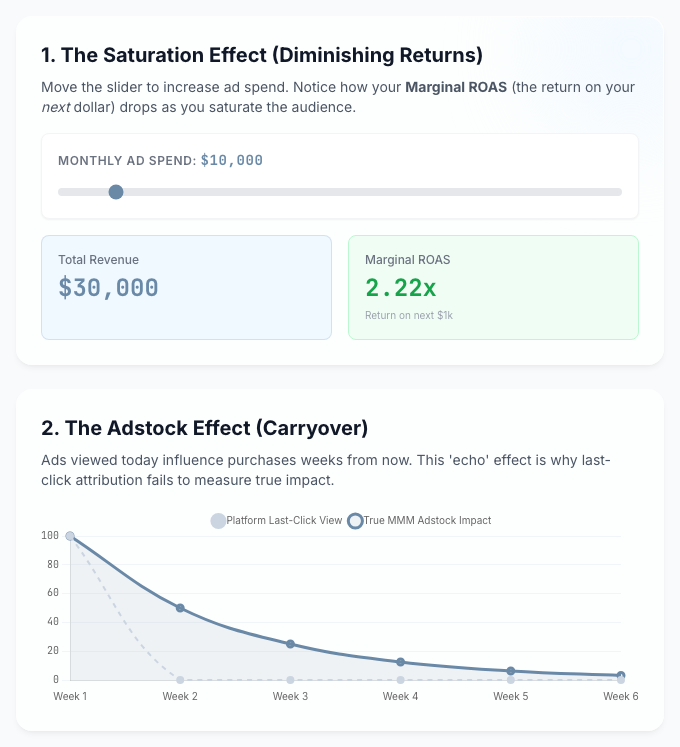
Caption: Dashboard explaining Ad Saturation and the Adstock carryover effect. Move the slider to see how Marginal ROAS decreases as spend scales.
Step-by-Step Breakdown
Data Integration: Marketing Mix Modeling aggregates historical weekly data, combining ad spend across all channels with business outcomes (sales) and external economic indicators.
Statistical Decomposition: Marketing Mix Modeling separates natural demand (sales you would get regardless of advertising) from incremental demand (sales directly driven by specific ads).
Applying Transformations: The model factors in 'Adstock' (the delayed impact of seeing an ad today but buying next week) and 'Saturation' (the point where spending more money stops generating proportional returns).
Generating Optimization Curves: Marketing Mix Modeling produces actionable response curves that tell marketers exactly where the next dollar of budget will generate the highest return.
The Core Data: Blind Scaling vs. Marketing Mix Modeling
We ran a data experiment allocating an identical $1.2M annual budget across Social, Search, and TV/Video. Scenario A relied on platform metrics, over-indexing on Social. Scenario B used Marketing Mix Modeling to shift budget dynamically before channels hit saturation.
Metric | Scenario A (Without MMM) | Scenario B (With MMM) | Our Verdict |
|---|---|---|---|
Total Annual Spend | $1,200,000 | $1,200,000 | Identical Baseline |
Total Revenue | $3,481,325 | $4,771,288 | +$1,289,962 (+37%) |
Overall ROAS | 2.90x | 3.98x | MMM highly superior |
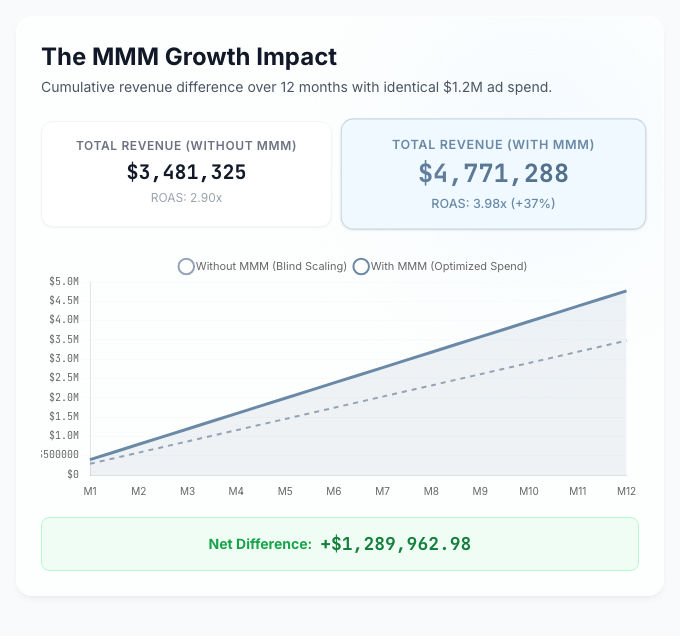
Caption: Cumulative 12-month revenue chart comparing the blind scaling trajectory against the optimized Marketing Mix Modeling trajectory.
The Expert Perspective
"AI doesn't read your content like a human; it parses your facts. If your facts are exactly the same as Wikipedia's, you won't get cited. The same logic applies to your ad spend: if you rely solely on the generic tracking pixels everyone else uses, you cannot build a proprietary growth engine. Marketing Mix Modeling turns raw data into a unique competitive moat."
Conclusion & Next Steps
Summary: Relying on basic platform metrics leads to budget saturation and wasted spend, whereas Marketing Mix Modeling unlocks the true marginal efficiency of every channel.
Action Plan: Now that you understand the financial impact of Marketing Mix Modeling, your next step is to begin aggregating your historical ad spend and sales data into a centralized data warehouse.
Frequently Asked Questions
Do I need a data scientist to use Marketing Mix Modeling?
No. While traditionally an enterprise discipline, modern SaaS tools and open-source libraries like Meta's Robyn and Google's LightweightMMM allow growth teams to run Marketing Mix Modeling without a dedicated econometrician on staff.
How is Marketing Mix Modeling different from Multi-Touch Attribution?
Marketing Mix Modeling is macro and privacy-safe, analyzing aggregated historical trends. Multi-Touch Attribution (MTA) is micro, attempting to track the specific, individual user journey across multiple touchpoints before a sale.
Does Marketing Mix Modeling require third-party cookies?
No. Marketing Mix Modeling relies entirely on aggregated, historical business data (like total spend and total revenue per week), making Marketing Mix Modeling completely immune to cookie depreciation and iOS tracking changes.
References & Sources Cited
Harvard Business Review: The New Rules of Marketing Measurement
Perspection Data Proprietary Simulation Repository
See you soon,
Team Perspection Data