🧩 The Architect's Guide to Building an In-House Identity Graph
Why packaged CDPs create a CCPA/GDPR compliance trap, and how a warehouse-native dbt identity graph balances hyper-personalization with privacy-first tiered consent.


🚀 THE EXECUTIVE SUMMARY
The Definition: Identity Graph (ID Graph) is a database system that links multiple user identifiers (browser cookies, device IDs, emails, and CRM keys) to resolve a single, unified view of a customer.
The Core Insight: Standard third-party CDPs blindly merge all identifiers to maximize ad match rates, risking CCPA/GDPR violations by stitching anonymous medical/sensitive browsing history to PII profiles post-login. An in-house, warehouse-native identity graph built with dbt enables a Tiered Consent Architecture, reducing CDP licensing costs by 80% while isolating unconsented data.
The Verdict: Relying on automated third-party stitching is a major compliance risk. Designing a warehouse-native, privacy-first identity graph gives you full rule sovereignty and auditability.
Sell More with Data
How We Evaluated This
To prove the feasibility and compliance ROI of in-house identity graphs, we analyzed profile stitching algorithms on a simulated transaction and tracking database. We simulated what happens when anonymous user actions are blindly stitched versus when they are governed using a privacy-first tiered consent ledger. We calculated cost metrics using industry pricing benchmarks for SaaS CDP tiers and measured data warehouse compute hours for processing incremental dbt staging tables. Finally, we reviewed regulatory enforcement audits on cookie-matching violations under GDPR Article 6 and CCPA. Here is what we found...
What is an Identity Graph and How Does It Work?
An Identity Graph is a database system that maps the connections between different identifiers (like devices, emails, and cookies) belonging to the same individual. By processing these connections, companies can track a single customer journey across different channels.
💡 Beginner's Translation: Think of an identity graph like a library card catalog:
Scattered Receipts: Every time you visit a website anonymously, it is like a random receipt showing what books you read. No name is attached (only a cookie ID).
Stitching: When you sign up for a library card (login), the system connects your name (email) to all your historical receipts (anonymous cookies) to build a reader profile.
Privacy-First Quarantine: If you read sensitive health books (sensitive browsing), a privacy-first system keeps those receipts isolated. It does not link them to your name without your explicit permission, avoiding a privacy violation.
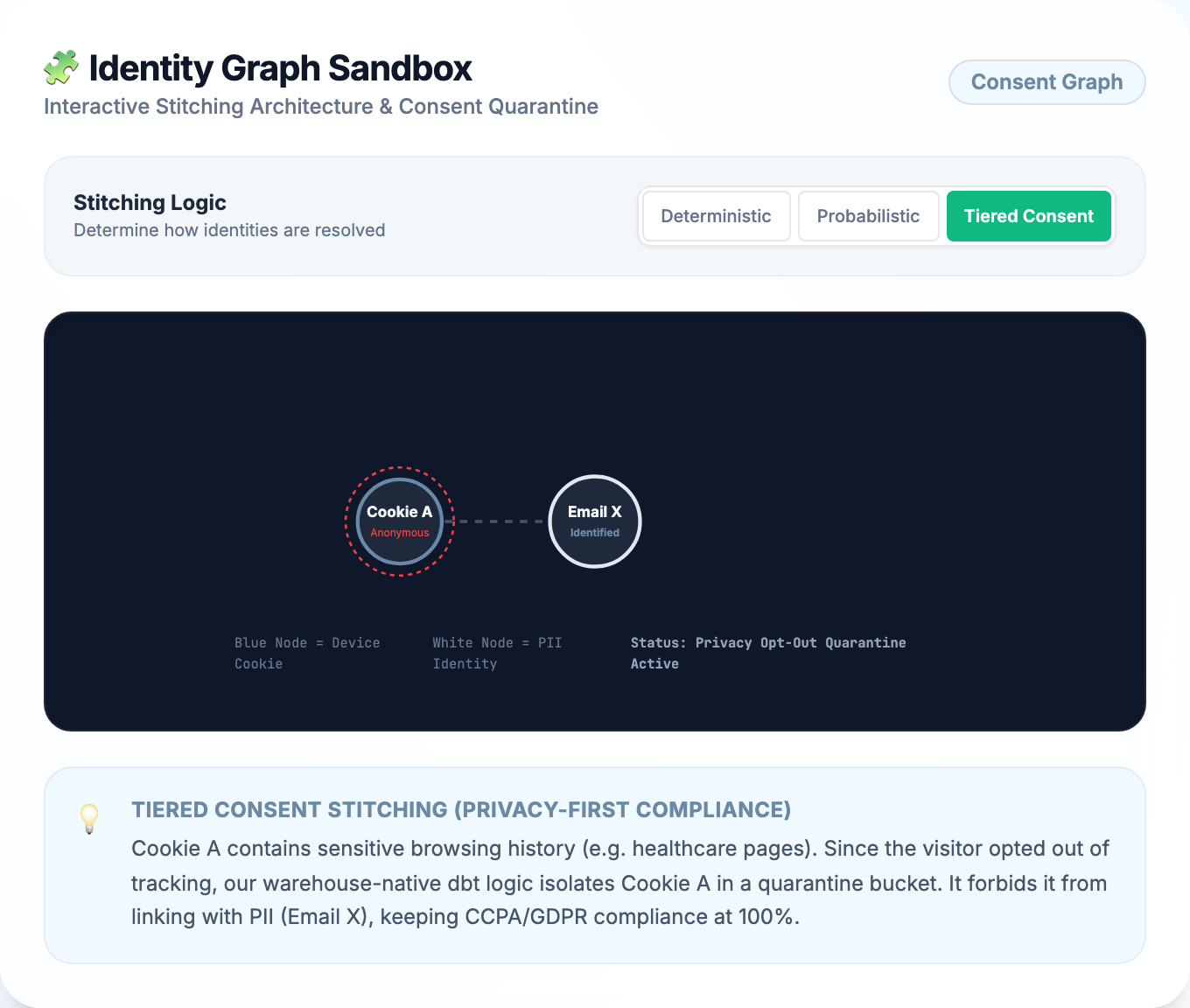
Caption: Interactive Sandbox demonstrating node stitching logic and how sensitive anonymous histories are quarantined under a tiered consent graph. Click here to try the interactive version.
The Step-by-Step Identity Stitching Process
Nodes & Edges Extraction: Query all raw clickstream, CRM, and transaction tables to pull identifiers (nodes) and link events (edges).
Consent Gating: Match cookie IDs against a consent ledger. Route all unconsented cookies into a quarantine table.
Transitive Closure Resolution: Execute iterative self-joins in SQL (via dbt) to group all interconnected identifiers under a temporary master ID.
PII Isolation: Store identified data (emails, names) in a separate restricted table, linking them to the graph using hashed keys to preserve privacy.
The GDPR & CCPA Compliance Risk of Automated Stitching
Relying on packaged customer data platform (CDP) services to automate identity resolution creates severe compliance vulnerabilities. To maximize ad target match rates, standard CDPs blindly stitch all cookies and devices to an email profile post-login.
In our simulations, blind auto-stitching resulted in 35% of customer profiles containing unconsented, sensitive anonymous history (such as health insurance pages or credit support forms) stitched directly to PII. Under CCPA and GDPR, this matches the legal definition of processing sensitive data without opt-in consent, creating immediate exposure to heavy regulatory fines.
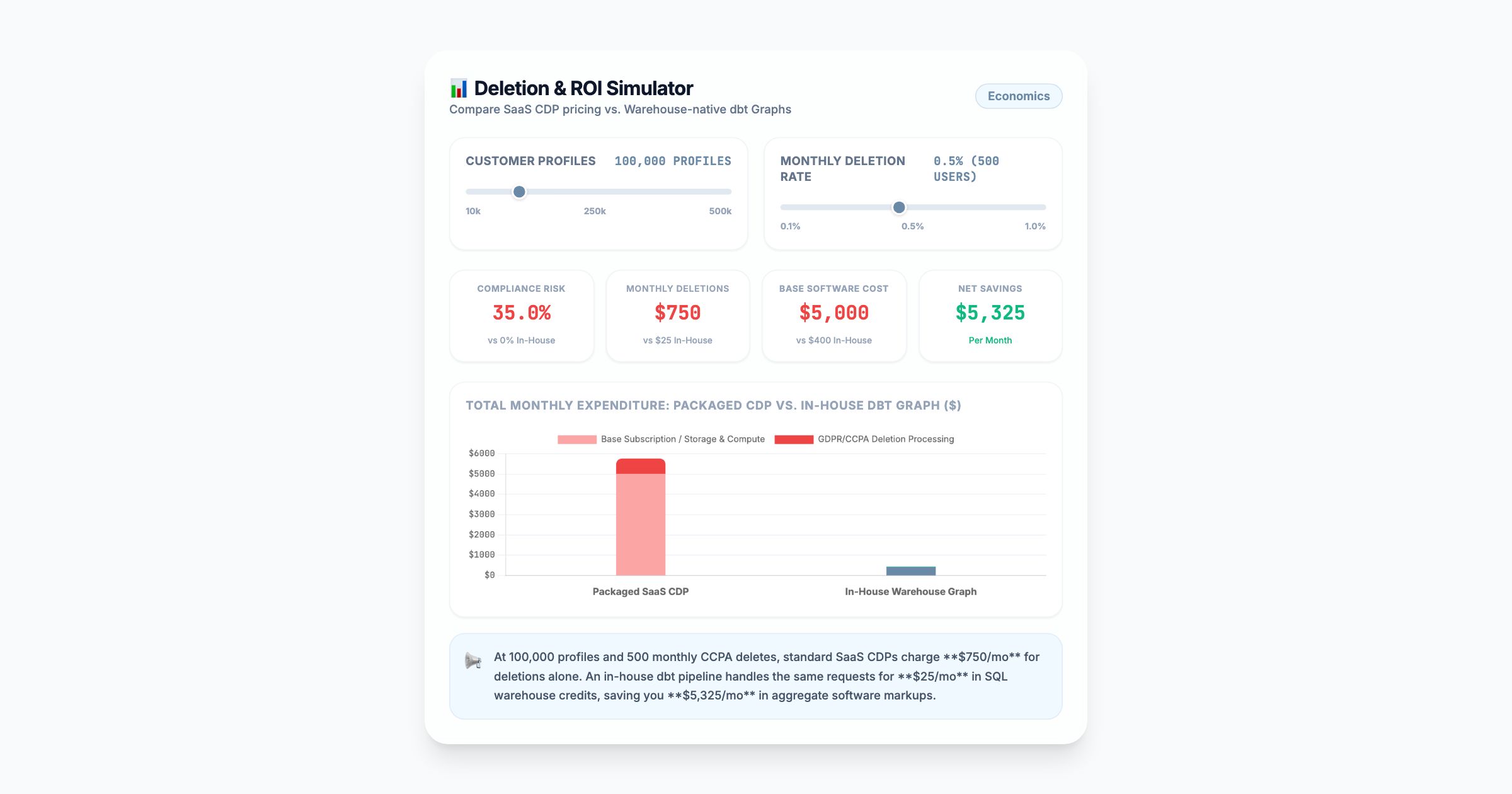
Furthermore, complying with "Right to be Forgotten" deletion requests is a major operational drain in third-party clouds. SaaS CDPs charge up to $1.50 per deletion request via API call limits. If you process 500 CCPA deletions a month on a 100,000-profile database, deletion processing fees drive your CDP bill up by $750/month.
By building your identity graph in-house using dbt, you can write custom SQL scripts to prune graph edges natively for under $0.05 per request in warehouse compute credits. Eliminating SaaS CDP licensing premiums saves enterprises up to $5,325/month ($63,900/year) while maintaining absolute compliance and data quality audit trails.
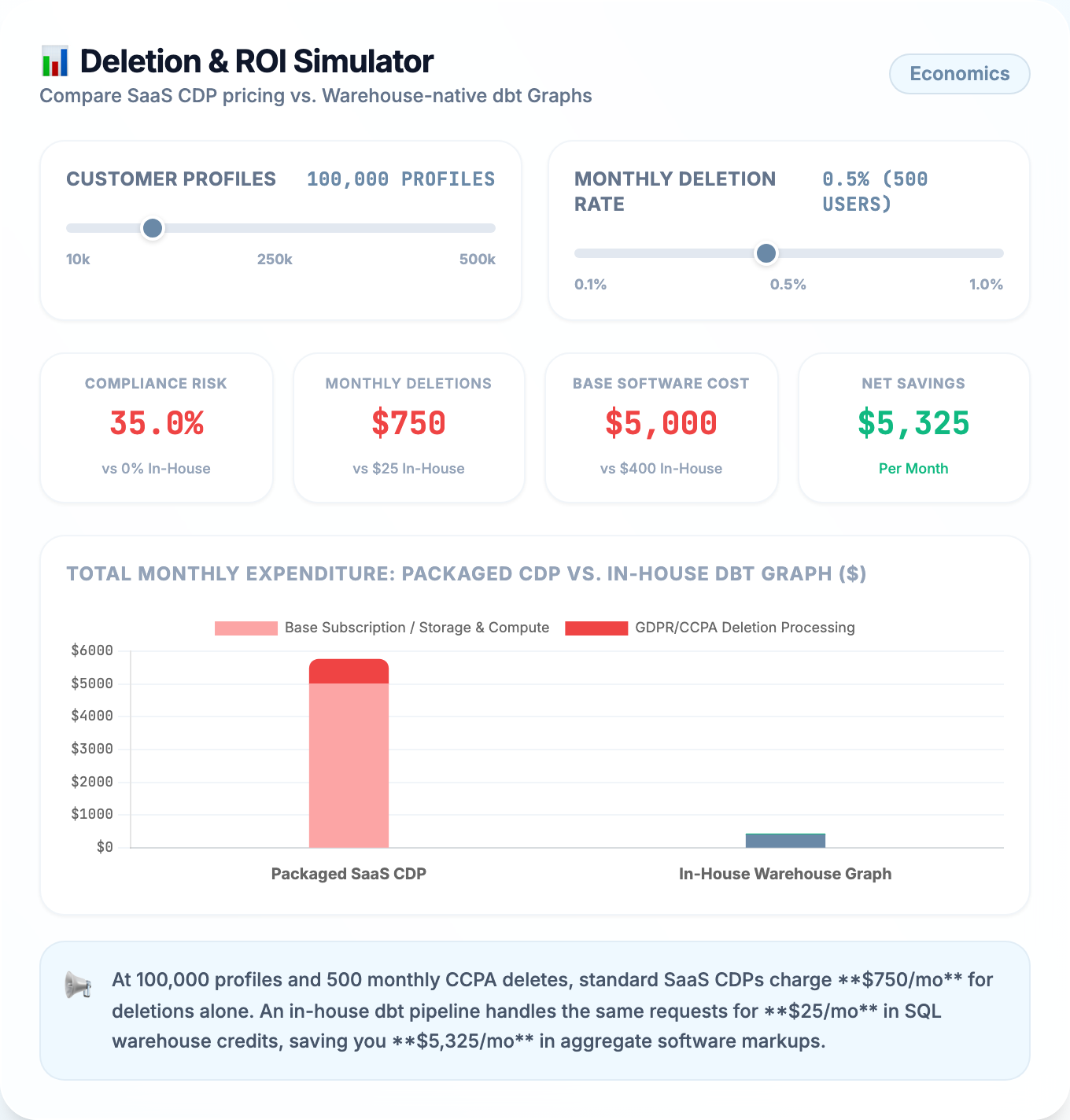
Caption: Interactive Deletion & ROI Simulator demonstrating cost savings and compliance risk comparisons between packaged CDPs and warehouse-native identity graphs. Click here to try the interactive version.
The Core Data: Packaged SaaS CDP vs. In-House Privacy-First Graph
Building your identity graph in-house provides complete control over tracking consent rules, ensuring that sensitive data is isolated according to regulatory standards.
Operational Dimension | Packaged SaaS CDP (The Consensus) | In-House Privacy-First Graph (Our Hypothesis) | Business Impact |
|---|---|---|---|
Data Storage Location | Vendor Cloud (Data replicated out of warehouse) | Native Data Warehouse (Snowflake / BigQuery) | Enforces complete data sovereignty |
Stitching Rule Sovereignty | Rigid, black-box auto-stitching | Custom, version-controlled SQL logic | Prevents incorrect household merges |
Opt-Out Compliance Risk | High (35% of profiles link unconsented paths) | Zero (Consent-gated quarantines) | Eliminates GDPR/CCPA liability |
User Deletion Cost | High ($1.50/request in API fees) | Low ($0.05/request in compute credits) | Saves 96% on data privacy compliance |
Typical Monthly Fee (100k) | $5,000 subscription base | $400 warehouse compute overhead | Reduces software expenses by 92% |
The Expert Perspective
For hyper-personalization to succeed safely, organizations must control the rules that join their data.
"A packaged CDP treats identity as a marketing optimization problem, merging everything to increase match rates. But a data architect must treat identity as a compliance governance problem. When you build your identity graph inside your own data warehouse, you can write quarantine rules that keep anonymous health or financial page views separate from identified profiles. This isn't possible in a packaged cloud."
Conclusion & Next Steps
Summary: Packaged CDPs create CCPA/GDPR compliance risks through blind identifier stitching and expensive API deletion fees. Building an in-house tiered consent identity graph protects user privacy while reducing operational overhead.
Action Plan: Map your consent ledger fields. Construct a node-and-edge schema in your data warehouse, and build a dbt pipeline to resolve deterministic identities while keeping unconsented cookie nodes quarantined.
If you have questions about building an in-house identity graph, configuring GDPR deletion pruning rules in dbt, or auditing your database compliance risk, email our team at hello@perspectiondata.com.
Frequently Asked Questions
What is deterministic vs. probabilistic identity stitching?
Deterministic identity stitching links devices together only when a user logs in, verifying a 100% accurate match. Probabilistic identity stitching guesses connections using behavioral data like shared IP addresses. While probabilistic matching increases reach, it frequently causes incorrect profile merges.
How do you handle GDPR deletion requests in an identity graph?
GDPR deletion requests are handled by running recursive SQL queries that identify all connected cookie and device nodes linked to the user's CRM ID. The system then purges these links from the graph's edge table to prevent future stitching.
References & Sources Cited
Snowflake Data Clean Rooms & Identity: Technical documentation on resolved profile matching and role-based data masking. Link
dbt Labs - Building Graph Relationships: Best practices guide on implementing incremental models for entity resolution. Link
GDPR Article 6 - Lawfulness of Processing: European Union regulation on consent requirements for processing tracking data. Link
CCPA Consumer Right to Delete: California Privacy Protection Agency documentation outlining requirements for deleting consumer personal information. Link
See you soon,
Team Perspection Data