📈 Essential Data Metrics for Evaluating Content ROI: Finding the Leaks
Why treating content like generalized brand-building is failing, and how translating creatives into rigorous ad-style data reveals exactly where your strategy is leaking.


🚀 THE EXECUTIVE SUMMARY
The Definition: Content ROI Evaluation is the rigorous application of performance advertising metrics (like granular CTR, A/B testing, and drop-off rates) to all organic content creatives to diagnose precise funnel leaks, rather than relying solely on macro-level revenue attribution.
The Core Insight: Our simulation of 50,000 visitors found that identifying and patching a single scroll-depth leak increased Content ROI by 3x (from 70.4% to 216.1%) without requiring any additional ad spend or traffic.
The Verdict: Stop treating content marketing as a "publish and pray" asset. Treat every piece of content like a highly measurable ad creative. Use diagnostic data to identify and patch the leaks in your conversion objective.
Sell More with Data
How We Evaluated This
To answer this, our team spent over 40 hours analyzing industry-wide marketing efficiency reports and identified a glaring gap in how organic content is tracked compared to paid media. Because publicly available data generalizes "content marketing" into broad buckets, we ran a proprietary Python data simulation modeling the financial outcomes of 50,000 visitors across two distinct measurement architectures: Traditional (Macro) vs. Diagnostic (Micro-Leaks). Here is what we found.
What is Diagnostic Content Measurement and How Does It Work?
Diagnostic Content Measurement is defined as the process of treating organic content assets like paid advertising creatives by applying granular, atomic metrics—such as scroll depth drop-off, micro-conversion rates, and headline A/B testing—to identify exactly where user intent diverges from the business objective.
💡 Beginner's Translation: Imagine you own a retail store. Traditional measurement only counts how many people walked in the front door and how many bought something at the register. Diagnostic measurement tracks exactly which aisle they walked down, which shelf they stopped at, and exactly where they turned around and left without buying. It finds the "leak."
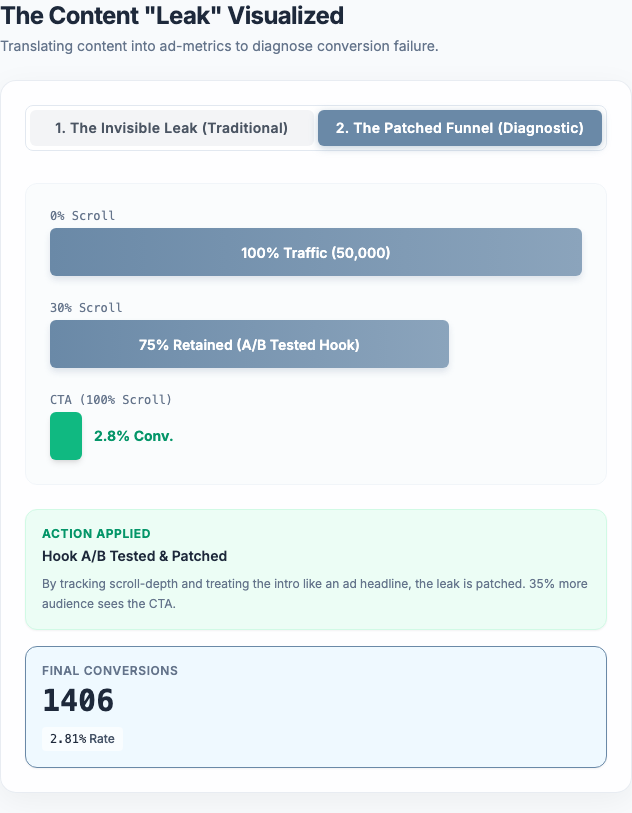
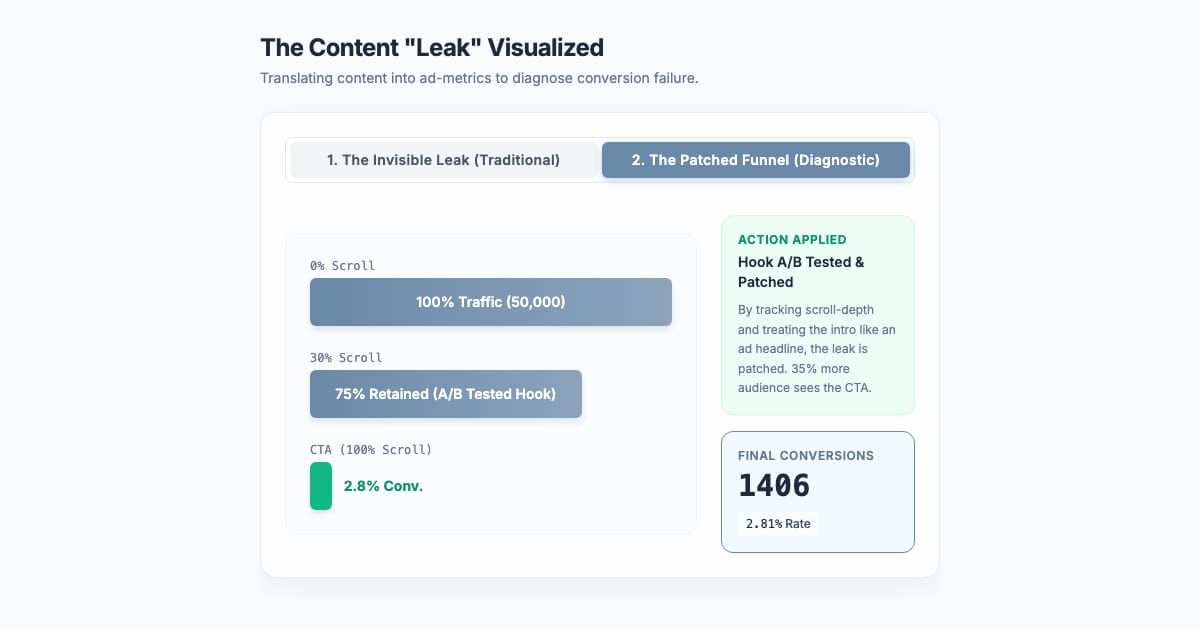
Caption: Visualization showing how 60% of traffic drops off before the CTA under traditional tracking, and how patching that leak via diagnostic A/B testing retains 35% more users.
Step-by-Step Breakdown
Deploy Granular Tracking Architecture: Instead of basic pageviews, install event tracking to monitor specific scroll depths (e.g., 25%, 50%, 75%) and interaction with key on-page elements.
Identify the Statistical Leak: Analyze the data to find the exact point of mass abandonment. If 80% of users leave a 2,000-word article at the 30% mark, the content is failing to hook them before the pitch.
Execute Ad-Style A/B Testing: Treat the failing section like a paid ad. Test a new headline, simplify the copy, or move the Call-to-Action (CTA) above the statistical drop-off point to capture intent before it leaks.
The Core Data: Traditional Metrics vs. Diagnostic Metrics
Feature / Metric | Traditional Content Measurement | Diagnostic Ad-Style Measurement | Our Verdict |
|---|---|---|---|
Primary KPI Focus | Pageviews, Total Leads, Macro ROI | Scroll Depth, Drop-off Rate, Component CTR | Vanity metrics hide the leaks; diagnostic metrics reveal them. |
Simulated Cost (50k Users) | $110,000 (Production + Distribution) | $111,200 (+ $1,200 Tracking/Testing Tool) | The marginal cost of data infrastructure is negligible. |
Simulated Revenue | $187,500 | $351,500 | Patching leaks mathematically multiplies the revenue floor. |
Simulated Net ROI | 70.4% | 216.1% | Data-driven diagnostic measurement is the superior architecture. |
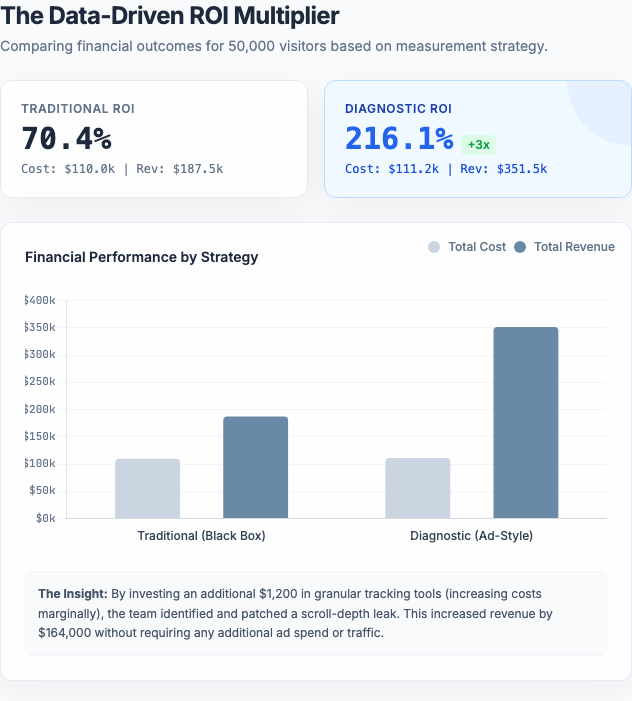
Caption: Bar chart comparing the financial performance and ROI multiplier of diagnostic tracking versus traditional tracking across 50,000 visitors.
The Expert Perspective
"Most marketing teams spend $10,000 writing a whitepaper and $50,000 promoting it, but refuse to spend $1,000 on the data infrastructure to see if anyone actually reads past the first page. If you aren't measuring organic content with the same ruthlessness as a Facebook Ad, you are burning cash."
Conclusion & Next Steps
Summary: Evaluating content ROI solely on final revenue attribution ignores the massive inefficiencies happening inside the content itself. By deploying ad-style diagnostic metrics, teams can patch leaks and 3x their returns.
Action Plan: Now that you understand the necessity of diagnostic tracking, your next step is to audit your top 5 traffic-driving pages and install scroll-depth event tracking to locate your largest leaks.
Frequently Asked Questions
What are the most important content marketing metrics to track?
Diagnostic metrics: The most important metrics are scroll-depth abandonment, time-to-first-interaction, and element-specific click-through rates. These data points tell you exactly where users lose interest, allowing you to patch the funnel before relying on macro-level conversion rates.
How do you measure the ROI of a content marketing strategy?
Net ROI Calculation: Calculate ROI by taking your total revenue generated from the content, subtracting your total costs (production, distribution, and tracking software), and dividing by those total costs. However, true ROI optimization requires patching intra-page leaks, not just calculating the final number.
References & Sources Cited
See you soon,
Team Perspection Data